
Thursday, December 6, 2012
Cold Snacks
Everyone loves beer. If you think you don't, you're wrong. A new brewing company was launched last week that calls itself "The Official Unofficial Beer of Montana", specifically targeting beer drinkers in Montana (everyone in Montana). Montucky Cold Snacks is the name, and cheap light beer in six packs is the product. It is the brainchild of two Montana natives, and although it is brewed in Lacrosse, WI, the brand has committed to donating 8% of profits to charities within Montana. Rad. The branding is very strong, the design of the label is simple and "Montanish", and it is a very average beer. Next time you're grabbing a pounder, why not support a new brand, and snag a Cold Snack.

The League

Andre, Chad Johnson, I mean Ochocinco, or is it Johnson again?, and a Bud Light
The FX show "The League" centers around a group of high school friends and their fantasy football league. It's mad funny, extremely vulgar, and depicts the characters as borderline sociopaths obsessed with stats and beating their friends within the league. While watching the latest episode, I realized how blatant the product placement is within the show. In almost every episode, The characters are shown with at least on Pizza Hut box, multiple Stella Artois, and a giant amount of Bud Light bottles. They also mention brands by name. Instead of saying "Grab me a beer." they will say "Grab me a Bud Light." This seems unnatural and forced. This doesn't take much out of the show, but instead makes the network seem cheap, or even desperate. Also, to me personally, the brands themselves seem to be struggling to gain consumers attention, which in a way hurts the brand identity.
Reppin'
The impact Red Bull has in sports is unreal. The amount of money the company is able to put into projects seems to be limitless. Two months ago they made history with the highest sky dive in history, beating the US Airforce's old record! I know this is old news, but the fact that a company selling energy drinks has generated enough money to send a man into space is still unbelievable. As I mentioned in a previous post, the strangest aspect of this relationship is that the very athletes that are receiving this money and support from Red Bull are usually not users of the product. Take, for instance, the New York Red Bulls soccer team. While they hit the field sporting Red Bull jerseys, I doubt that any player fuels up on the beverage before the game, or possibly ever for that matter. The fact remains that energy drinks are bad for you, and do not lead to increased performance.
 However, since the inception and current market saturation of these companies, athletes have been given the opportunity to travel to places and realize goals that would be impossible without the massive corporate sponsorships they have been awarded. Is it better to have an athlete sponsored by a product they clearly don't use, but be able to do anything they dream of, or to have athletes stand behind their brands and only receive limited resources?
Back In My Day, We Wore Shorts
This advertising campaign for Pepsi Max is amazing. The concept of a superstar baller looking like an old man is a good metaphor for a zero calorie soda that suppposedly tastes the same. The execution is perfect, and the results are incredible. Best ad of the year, hands down.
Pusher Man
Biggie's St. Ides Commercial (1995)
There have been some major deals throughout the history of rapping, with one of the largest early payments, and a later shoe line, going to Run-DMC for the classic "My Adidas". Many other artists in the early stages of rap would name drop products, and later receive money from said company as a thanks for the promotion. These deals were usually not agreed upon in advance of the recording, rappers were simply versing about products they were fans of and companies that stood as status symbols. Currently, almost all major hip hop stars engage in some type of product promotion, and frequently appear in advertisements. Kurtis Blow's 1986 Sprite commercial was one of the first direct promotion of a product by a rapper.
Needless to say, Blow's the man
This later led to some artists realizing the potential gain from name dropping, and consciously trying to get the attention of a brand by consistently mentioning it on tracks. In my opinion, some of B.O.B.'s work seems to be trying to gain corporate attention. In the track "Fly Like Me", B.O.B mentions LRG, Creative Recreations, Cadillac, Dodge Charger, Maybach, Moschino, Academik, Oakley, and Roland TR-808 (drum machine)! While B.O.B. is all over the place with his company choices, others narrow the selection down, and have been met with mixed results. After Jay-Z gained the attention of Cristal, they asked him to stop mentioning their product, and even went as far to say (when asked if the presence in hip hop culture was harmful to the brand) "What can we do? We can't forbid people from buying it". Jay-Z claimed racism, and when reading the details, it seems that may not be far off.

This discrepancy between promoting brands for little or no return, and sometimes even negative responses, has led to the latest trend in rap, where artists use their star status and verses to promote their own brands. After the Cristal fiasco, Jay-Z stated he would never drink Cristal again and invested in Armand de Brignac, commonly referred to by Hova as "Ace of Spades." Jay now pulls an estimated 4 million dollars yearly from the sales of Armand, and is also responsible for it's rising popularity. Diddy owns a huge portion of the vodka brand Ciroc, and acquired it simply by pledging to promote the company. Many other rappers own shares of large scale brands, which reminds me of a favorite Jay-Z line, off the Kanye track "Diamonds from Sierra Leone (Remix)", "I'm not a businessman, I'm a business...man"
Wednesday, December 5, 2012
Team Mountain
Three summers ago, I had the opportunity to work for Nature Valley Granola. To sum it up, it was amazing. My friend Jay and I traveled to ten parks over a ten week period, taking pictures, making videos, and handing out hundreds of boxes of Nature Valley bars. The first hand marketing experience we gained was incredible, and we had a great time doing it.
This project was a joint effort to promote Nature Valley and the National Park Conservation Alliance's Preserve The Parks Campaign, an ongoing effort to help conserve national parks. Work is still being done on this project, including fence removal outside of Yellowstone National Park. I can't help but give our old blog a shameless plug, so here it is!
Team Mountain 2010
This project was a joint effort to promote Nature Valley and the National Park Conservation Alliance's Preserve The Parks Campaign, an ongoing effort to help conserve national parks. Work is still being done on this project, including fence removal outside of Yellowstone National Park. I can't help but give our old blog a shameless plug, so here it is!
Team Mountain 2010
History of the Swoosh
 |
| Nike Freeze, inspired by the swoosh |

- The swoosh was created in 1971 by Carolyn Davidson.
- She was initially paid $35 for the logo, at a rate of $2 an hour.
- Phil Knight, when shown the logo, said "I don't love it, but I think it will grow on me."
- Phil Knight later gave Davidson a diamond swoosh ring, along with 500 shares of Nike stock.
- The stand-alone swoosh premiered in 1995.

While a gold and diamond swoosh ring is pretty amazing, the real satisfaction Carolyn Davidson has received has been seeing the growth of her logo, and the brand it would come to embody. Also, the 500 shares of stock she later received are currently worth (due to four 2-for-1 splits and a stock price of $97.90) around $780,000, not bad for a days work!
Next time you slip on those fresh Dunks, give props to Carolyn Davidson, the designer behind the most iconic sportswear logo in history.
Tuesday, December 4, 2012
Sweatin'
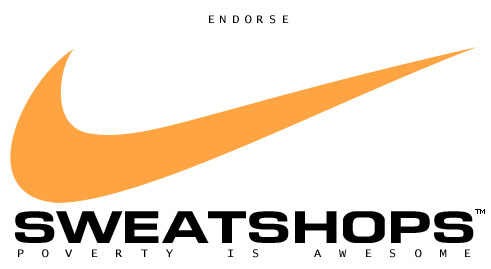
I read an extremely interesting topic today concerning the positive effects of sweatshops in developing countries. While most of us are against sweatshops, and feel as if they are exploiting the world's poor, this may not be the case. The alternatives to sweatshop work must be considered before the concept is dismissed entirely. For instance, what other job markets are open in places such as Sub-Saharan Africa?
When presented with the choices of working in a mine or as a prostitute, the sweatshop is the highly preferred, less dangerous choice.
However, the concept of sweatshops as a valid way for third world countries to increase employment levels, build GDP and infrastructure, and enter the global market is not what I was intrigued by. (If you are, read more here) The concept of sweatshops as a positive approach to conducting global business and the marketing implications of this approach could become outlandish.
Imagine if Nike introduced a campaign about how they are proud to help developing countries through sweatshop job opportunities. Would the public understand, or would there be another round of boycotts? While no definitive answers will be found until a company has the guts to pull such an extreme move, it is an interesting concept to consider.
Subscribe to:
Comments (Atom)